Title: Emission Solex DIDSA 5 and DIDSA 9 carburetters
Reason: Service Difficulties
Charges U. K. - Warranty .............NO
EXPORT - Factory ............. NO
- Distributor ..........NO
Action: The carburetters can be regarded as having three separate functions,
(see illustrations):-
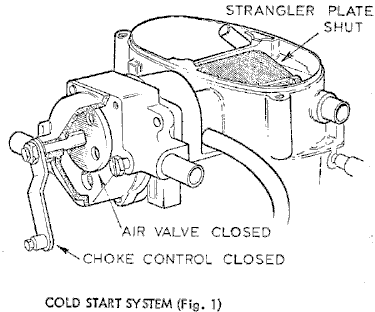
1. Provision for cold starting (Fig. 1)
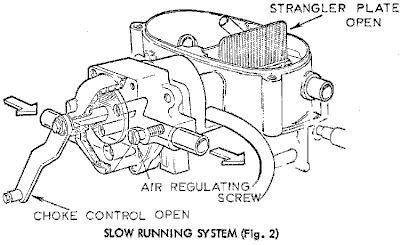
2. Provision for idling with strict control of emissions (Fig. 2)
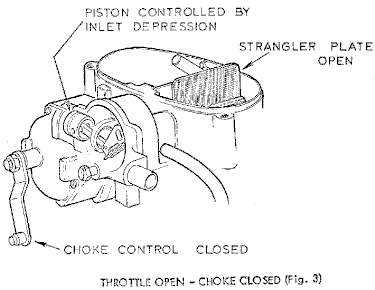
3. Normal running of the engine (Fig. 3)
In the case of the DIDSA 9 carburetter, provision is also made for Evaporative
Loss Control (see Service Bulletin 1971/21 and 1971/021, Class 111), but the operation
of the three Functions mentioned above is not affected by this.
Cold Start System
The driver's choke control operates indirectly a strangler plate in the primary
choke. A lost motion linkage provides for an override control operated by a piston
influenced by engine depression. The air bleed for the slow running by-pass system is
positively closed by operating the choke control fully through a plate valve contained
in the choke/by-pass housing. For starting an engine from cold, the sequence of
operations is therefore:-
1. Apply full choke:
This closes the slow running by-pass valve and should close the strangler plate.
It also opens the throttle butterfly in the primary choke a pre-determined amount to
provide a fast idle.
2. Energise the starter motor:
The depression created in the inlet manifold will draw a rich mixture From the
carburetter. Excessive depression, acting on the override control in the carburetter,
will automatically open the strangler plate to avoid flooding.
3. Allow the engine to fast idle until normal operating temperatures are reached,
progressively returning the choke control to maintain even running.
 Starting an Engine from Warm
1. Apply partial choke - energise starter:
This will provide a richer mixture by partially opening the strangler plate.
The primary throttle Butterfly may be partially opened and the slow running
by-pass may be slightly closed.
2. Progressively return the choke control to maintain even running.
Starting an Engine Hot
1. Partly open the throttle - energise starter.
Slow Running (idle) System
In order to comply with emission requirements, strict control of the idle
mixture is required. For this reason the 'normal' idle stop screw is not fitted,
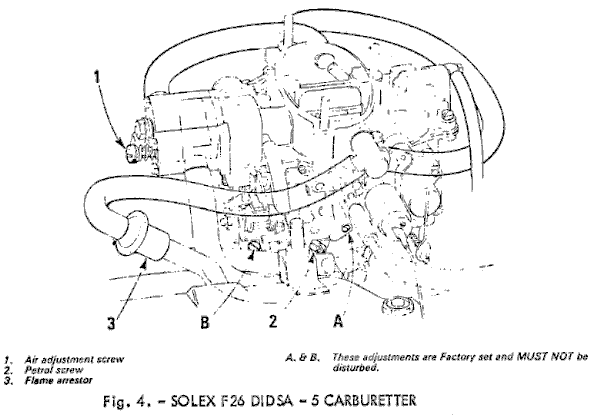
control of the idle r.p.m, and mixture being given by the air bleed screw, (1 of
Fig. 4) and the idle mixture screw (2 of Fig. 4). The screw (B of Fig. 4) which
is locked with paint (or similar) is Factory set and MUST NOT BE ADJUSTED.
The purpose is to control the amount of throttle opening on fast idle (when the
choke is in use) but misadjustment can open the throttle butterfly at all times,
making it impossible to properly set the idle/r.p.m. mixture.
To Set Idle R.P.M.
Before setting the idle r.p.m. (ideal setting 1050 r.p.m, acceptable 950 r.p.m.)
it is essential to ensure that the following items are in correct condition.
a. Valve clearances (cold) Inlet .008 in.(.203 mm.) Exhaust .010 in.(.254 mm.)
b. Contact breaker points gap .016/.019 in.(.406/.472)
c. Sparking plugs points gaps .020/.023 in.(.508,/.584) (Champion N7Y)
d. Ignition timing TDC Static (advance inoperative BELOW 1500 r.p.m.)
Starting an Engine from Warm
1. Apply partial choke - energise starter:
This will provide a richer mixture by partially opening the strangler plate.
The primary throttle Butterfly may be partially opened and the slow running
by-pass may be slightly closed.
2. Progressively return the choke control to maintain even running.
Starting an Engine Hot
1. Partly open the throttle - energise starter.
Slow Running (idle) System
In order to comply with emission requirements, strict control of the idle
mixture is required. For this reason the 'normal' idle stop screw is not fitted,
control of the idle r.p.m, and mixture being given by the air bleed screw, (1 of
Fig. 4) and the idle mixture screw (2 of Fig. 4). The screw (B of Fig. 4) which
is locked with paint (or similar) is Factory set and MUST NOT BE ADJUSTED.
The purpose is to control the amount of throttle opening on fast idle (when the
choke is in use) but misadjustment can open the throttle butterfly at all times,
making it impossible to properly set the idle/r.p.m. mixture.
To Set Idle R.P.M.
Before setting the idle r.p.m. (ideal setting 1050 r.p.m, acceptable 950 r.p.m.)
it is essential to ensure that the following items are in correct condition.
a. Valve clearances (cold) Inlet .008 in.(.203 mm.) Exhaust .010 in.(.254 mm.)
b. Contact breaker points gap .016/.019 in.(.406/.472)
c. Sparking plugs points gaps .020/.023 in.(.508,/.584) (Champion N7Y)
d. Ignition timing TDC Static (advance inoperative BELOW 1500 r.p.m.)
 Normal Running
Other than the cold start system and the emission idle circuit, both of which
are out of operation when driving at higher r .p.m., the remainder of the carburetter
is normal Solex in operation, that is, it has the standard functions of a fixed
carburetter.
Normal Running
Other than the cold start system and the emission idle circuit, both of which
are out of operation when driving at higher r .p.m., the remainder of the carburetter
is normal Solex in operation, that is, it has the standard functions of a fixed
carburetter.
 Fault Diagnosis
IT IS ASSUMED THAT THERE IS AN ADEQUATE SUPPLY OF PETROL TO THE CARBURETTER
AND THAT IGNITION SYSTEM, SPARKING PLUG GAPS AND VALVE CLEARANCES ARE
CORRECTLY SET AND IN GOOD ORDER.
1. Difficulty in Starting a Cold Engine
Check that the strangler plate is moving in harmony with the choke lever, if
not.- why not. Look For bent spindle, seized spindle, control piston seized or
jammed in bore (visual check).
2. Erratic Idle
a. Check that the Factory set screws hove NOT been disturbed.
b. Reset idle by approved method ONLY.
c. Check solenoid valve jet and idle mixture screw For blockage.
3. Incorrect Idle
a. Check that the Factory set screws have NOT been disturbed.
b. Check throttle mechanical linkage to ensure proper return of throttle
butterfly to closed position.
c. Check choke mechanical linkage to ensure proper return of choke linkage
to 'off' position.
d. Check freedom of movement of fast idle actuating rod.
e. Reset idle by approved method only.
Fault Diagnosis
IT IS ASSUMED THAT THERE IS AN ADEQUATE SUPPLY OF PETROL TO THE CARBURETTER
AND THAT IGNITION SYSTEM, SPARKING PLUG GAPS AND VALVE CLEARANCES ARE
CORRECTLY SET AND IN GOOD ORDER.
1. Difficulty in Starting a Cold Engine
Check that the strangler plate is moving in harmony with the choke lever, if
not.- why not. Look For bent spindle, seized spindle, control piston seized or
jammed in bore (visual check).
2. Erratic Idle
a. Check that the Factory set screws hove NOT been disturbed.
b. Reset idle by approved method ONLY.
c. Check solenoid valve jet and idle mixture screw For blockage.
3. Incorrect Idle
a. Check that the Factory set screws have NOT been disturbed.
b. Check throttle mechanical linkage to ensure proper return of throttle
butterfly to closed position.
c. Check choke mechanical linkage to ensure proper return of choke linkage
to 'off' position.
d. Check freedom of movement of fast idle actuating rod.
e. Reset idle by approved method only.
Resetting after Misadjustment
Should any alteration have been made to the Factory set screws these should be reset
to the original positions (if known). Where the original setting has been completely
lost the following procedure should be carried out. This will give an approximation to
the original settings.
Screw 2 of Fig. 4 Unlock the screw and screw out (anticlockwise) until with the throttle
mechanism held shut, play can be felt between the fast idie link and the operating rod.
Now screw in (clockwise) the fast idle screw to give approximately .005 in. (.127 mm.)
free play.
Screw 1 of Fig. 4 Adjustment of this screw should be carried out with the engine running.
From idle slowly open the throttle. If a 'hesitation' or 'flat spot' is apparent, the
screw should be turned anticlockwise until the 'hesitation' just disappears. Relock
the screw.
The normal running adjustment should now be carried out.
IN ALL CASES BEFORE MAKING ANY ADJUSTMENT ENSURE THAT THE SCREW SETTINGS ARE AS ORIGINAL.
N.B. BEFORE ATTEMPTING TO RECTIFY A REPORTED DEFECT IN CARBURATION ENSURE:
1. CORRECT VALVE CLEARANCES AND CONDITION
2. CORRECT IGNITION SETTTING AND CONDITION
3. THAT FACTORY SET SCREWS ARE ORIGINAL OR THAT RESETTING
FOLLOWING THE NOTES HAS BEEN CARRIED OUT
4. THAT THE AIR CLEANER ELEMENT IS NOT PARTIALLY BLOCKED - WHICH
WILL SERIOUSLY AFFECT PERFORMANCE
Note on Idle Mixture
Because of the exhaust emission requirements the maximum available mixture for
idle is necessarily kept to the minimum. It has been found on occasion that the
fuel requirements of the engine in service may, under certain conditions, exceed
the maximum supply. Should this happen IN U.K. CARS ONLY, the slow running jet may
be increased in size. Both '50' and '60' jets are available. Naturally before any
action is taken in this respect, the points detailed above and the general condition
of the engine should be checked.
Where the idle mixture screw has to be screw out so far that it is no longer in
safety, the orifice may be drilled out from .5mm. to .6 mm. (see sketch). This
allows the needle to be further in for the same flow.
Fault Diagnosis faults peculiar to Emission Solex Carburetters
Difficult Cold Starting attributable to carburation.
Remove top cover of air cleaner and visually check that strangler plate closes when
full choke is applied. If not, check reason for limited movement and rectify.
'Hang Up' on Idle R.P.M.
(a) Check that throttle mechanism is free to return to 'throttle closed'
position - rectify.
(b) Remove air cleaner and recheck for 'hang up'. If absent, fit new air cleaner.
(c) If screw 1 of Fig. 4 has been disturbed, weakening (by turning clockwise) may
make an improvement.
'Running-On'
With r.p.m, at idle, disconnect solenoid, shut off valve at 'Lucas' terminal. If engine
continues to run, replace solenoid valve. Other than faults common to all carburetters-
blocked jets etc., experience indicates that the majority of problems are caused by
tampering with the pre set screws GOING BACK TO STANDARD will normally rectify obscure
problems.
|
